Autopsy of a Game Economy: How Axie Infinity's SLP Died, and What Would Have Saved It
TLDR: Smooth Love Potion (SLP) — the reward token of Axie Infinity, the game that defined "play-to-earn" — peaked at $0.364 on May 1, 2021, collapsed 99.88% peak-to-trough, and never recovered. The proximate cause wasn't the Ronin bridge hack or the crypto bear market: the price was already down 90% by December 10, 2021 — two months before the big Season 20 emission cut and three months before the hack. The cause was structural: SLP's faucet was wired to player headcount while its sink was wired to player growth. On-chain data shows daily net emission turned structurally positive on May 12, 2021 — eleven days after the price peak. We rebuilt the economy as a small cohort simulation and ran the counterfactuals: applying Axie's own −55% emission cut at the price peak instead of seven months later extends the economy's solvent life by ~120 days (+57%) and more than doubles cumulative player-days; tripling sink strength buys only ~30 days; and replacing the volatile reward token with fixed-USD stablecoin rewards — the design the industry converged on by 2026 — eliminates the death spiral entirely.
Every number here is computed by the repo's pipeline from price history (through Aug 2026) and Ronin on-chain mint/burn/address data. You can re-run every counterfactual — and design your own — in the interactive simulator.
How a P2E economy is supposed to work
A play-to-earn economy has three plumbing fixtures:
- Faucets mint the token: play the game, receive SLP. In peak-era Axie a grinder could clear ~150 SLP/day (daily quest 50, adventure cap 100 — later halved, then removed entirely).
- Sinks burn it: breeding new Axies cost SLP (from 100 SLP per parent at launch to 900+ after December 2021), and later, crafting runes and charms.
- The market sets the price where earner sell-pressure meets sink demand.
The catch is who demands the token. Breeding is only worth doing if there's someone to sell the offspring to — a new player. So sink demand is a bet on growth: earners sell tokens in proportion to how many players exist, while spenders buy tokens in proportion to how many players are arriving. Any headcount-vs-growth mismatch lands on the price. While growth accelerates this works beautifully, and reflexively: price up → daily earnings up (a Filipino scholar could out-earn local wages in mid-2021) → more players arrive → more breeding demand → price up. The same loop runs in reverse with no brakes: growth stalls → breeding demand dies → price falls → earnings fall below opportunity cost → players churn → demand falls further. That reverse gear is the death spiral, and it isn't a tail risk — it's the guaranteed end-state, because growth always stalls eventually.
The autopsy
The death spiral
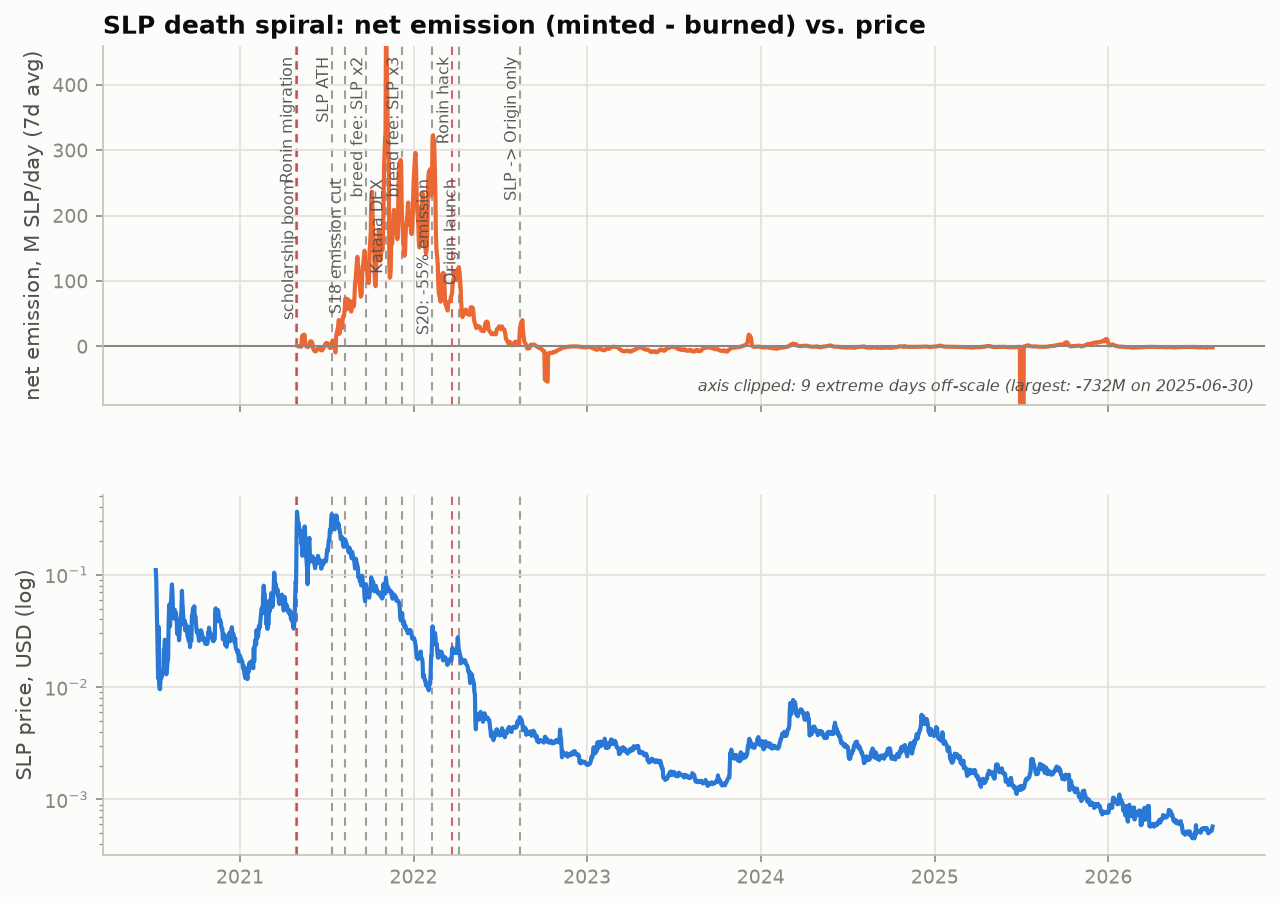
In our merged series SLP peaked at $0.3642 on May 1, 2021, with a twin top near $0.36 in mid-July (aggregators disagree on which spike was the all-time high; CoinGecko's official print is $0.3997 on July 13). From the May peak: −50% in 11 days, −90% in 223 days, −99% in 411 days, and −99.88% peak-to-trough to $0.000451. Note the ordering on the chart: the price top comes before Season 18's first emission cut — the interventions chased the collapse, they never led it.
Faucet vs. sink
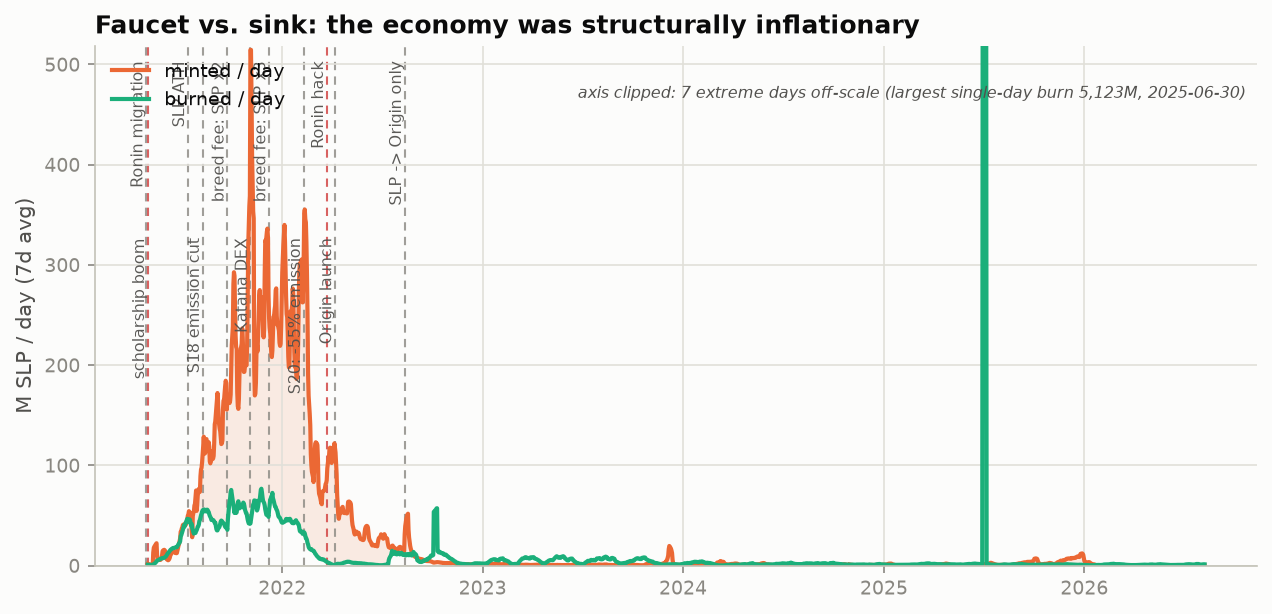
Sky Mavis's own Season 20 post concedes the mint/burn ratio had reached ~4:1 (~320M SLP/day minted, ~80M burned); our chain data peaks at ~430M/day net emission (7-day average) in late 2021. Net emission went structurally positive on May 12, 2021 — eleven days after the price peak — and stayed positive through the entire collapse; cumulative Ronin supply reached 43.3B SLP by September 2022. The economy wasn't occasionally inflationary; it was inflationary as a design constant, with the deficit financed by new-player buy-in.
One measurement caveat: SLP is minted when players claim, and claims batch up to 14 days of earnings. The single biggest "mint" day — 1.2B SLP on November 4, 2021 — is players cashing out en masse the day the Katana DEX opened, not a change in earn rates.
Player growth vs. price
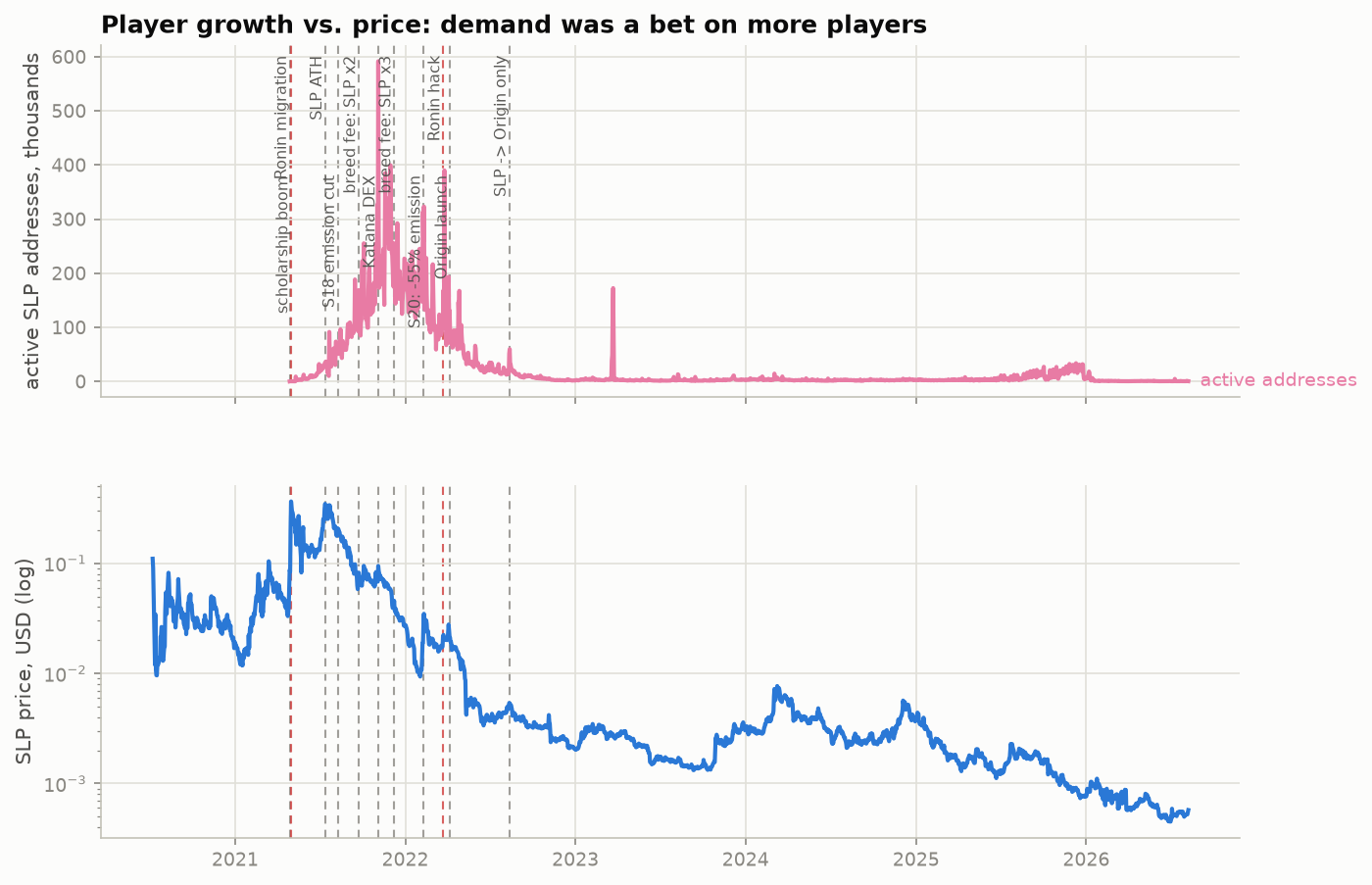
Addresses touching SLP on-chain peaked at 591,569 on November 4, 2021 (Sky Mavis reported ~2.7M DAU that month; most players don't claim daily) — 187 days after the price peak. The marginal player was recruited by yesterday's earnings screenshot, so headcount kept growing for six months into the price collapse. By mid-2022 active addresses were down 94% from peak; by end-2022, down 99.7%. When growth rolled over, the last source of sink demand — breeding for incoming players — went with it.
Did the interventions work?
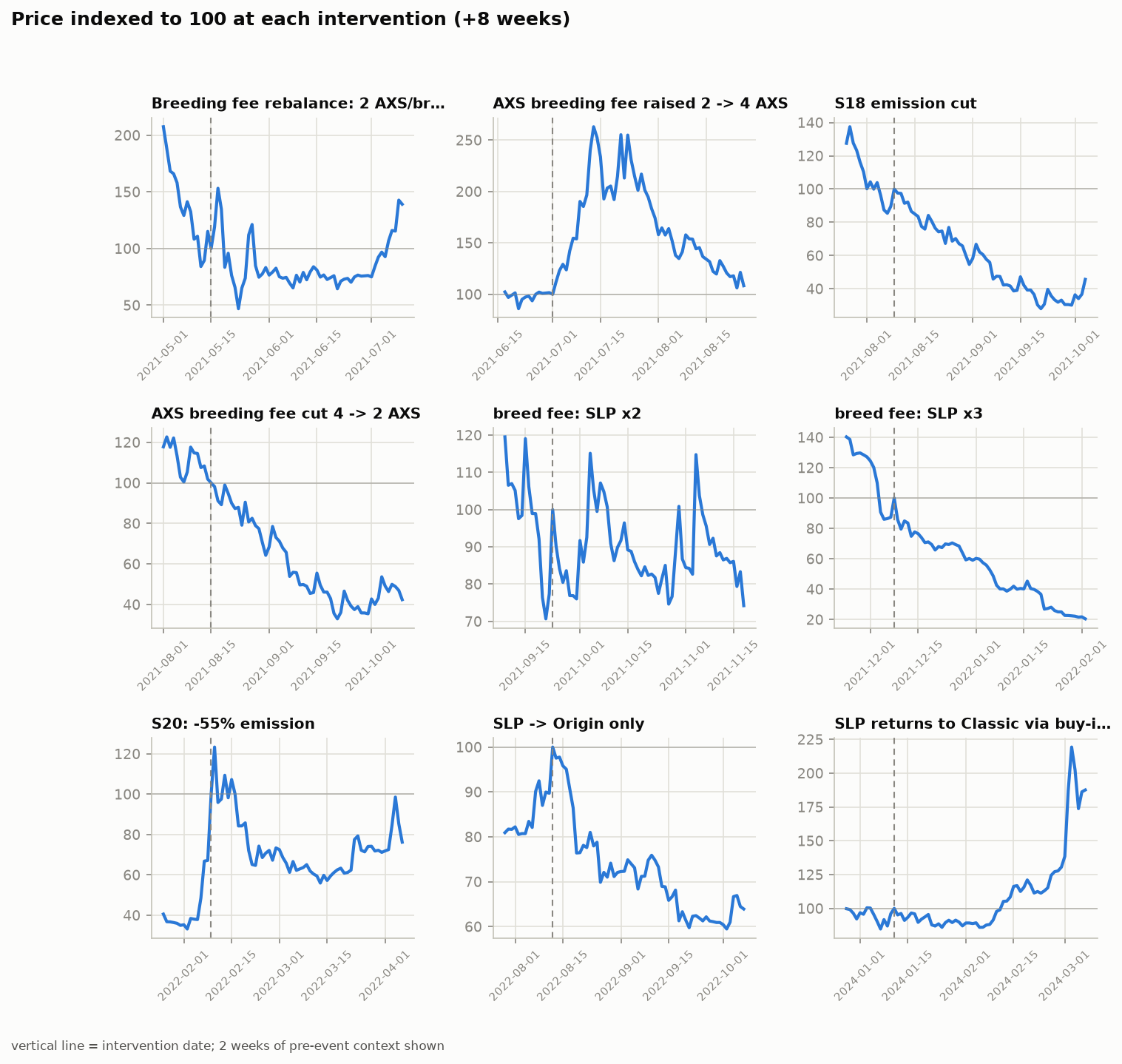
- Season 18 (Aug 2021, first emission cut): no bounce at all; −54% within 8 weeks — and net emission rose from 43M to 108M/day, because the player boom was still accelerating past the cut.
- September 2021 breeding-fee doubling: +15% pop, given back in 12 days; −26% at 8 weeks; net emission kept climbing (123 → 189M/day).
- December 2021 breeding-fee tripling: no pop; −80% at 8 weeks.
- Season 20 (Feb 2022, −55% of all emission): +23% pop with a bounce half-life of two days; −24% at 8 weeks. It did cut net emission from 261M to 114M/day — the biggest real effect of any intervention — and the price still made new lows within the window.
- The one clear positive: the January 2024 buy-in coliseum (a pure net sink) coincided with +88% at 8 weeks — but by then SLP was a $0.003 token in a net-deflationary museum economy, three years after it mattered.
Cutting the faucet after the demand engine has died changes the slope of the decline, not its direction.
The model
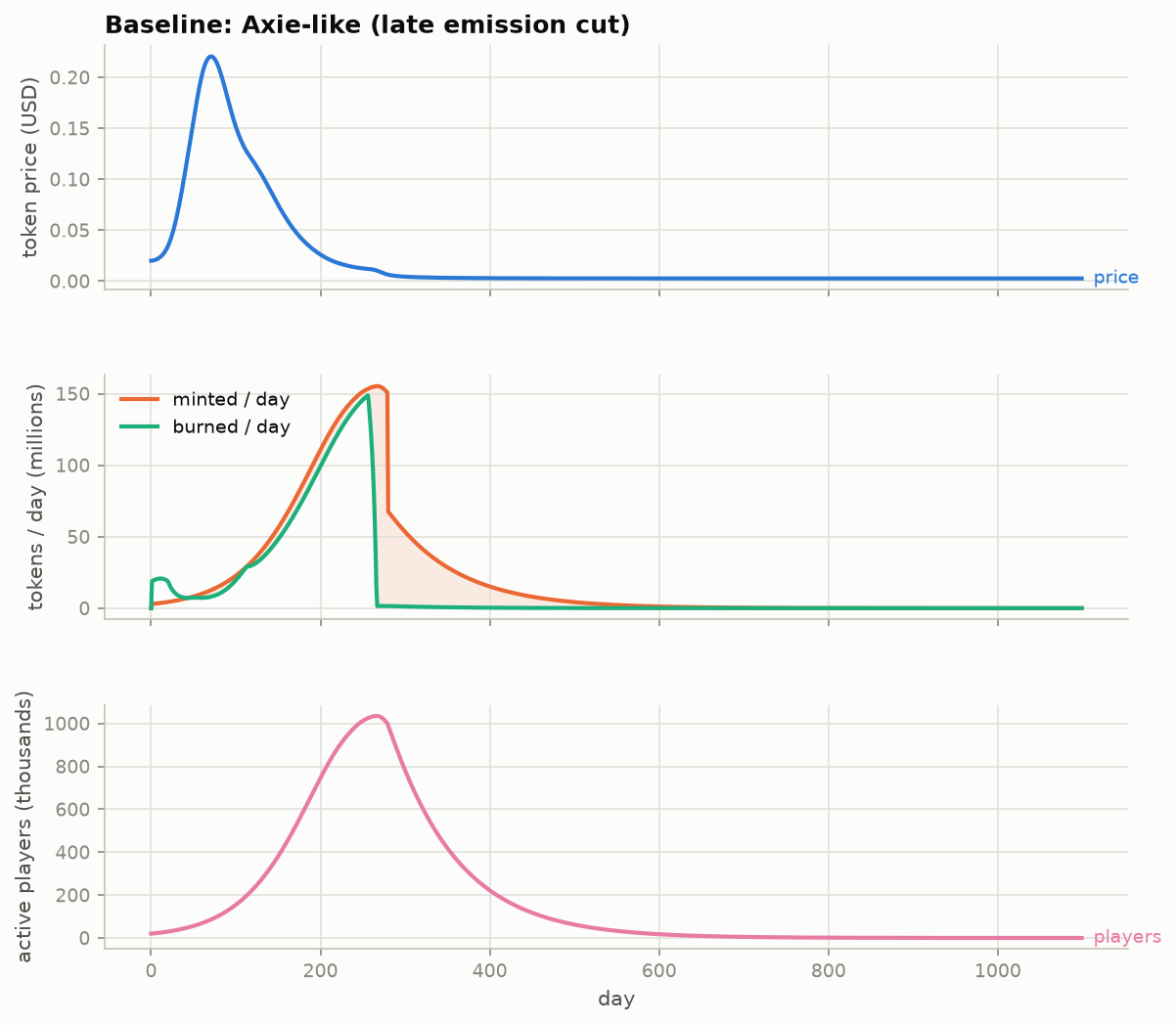
sim/model.py is a deliberately small discrete-time cohort
model — ~80 lines of mechanism, no agent soup:
- Earners receive an emission per active player (150/day, the real peak-era earn rate) and sell 90% for fiat.
- Spenders: each net-new player creates a fixed USD amount of breeding demand, bought off-market and burned; a small baseline sink burns independent of growth. This pro-cyclical sink is the load-bearing assumption of the whole model.
- Speculators trade the 14-day trend, amplifying both directions.
- Population grows when daily earnings clear a target ($2/day) and churns when they don't, capped by a market-size ceiling (2M, from Axie's real peak DAU).
- Price is a toy impact model, stated honestly: dP/P = k · (buys − sells) / supply, EMA-smoothed. It is the simplest relation that lets imbalances compound; it is not market microstructure.
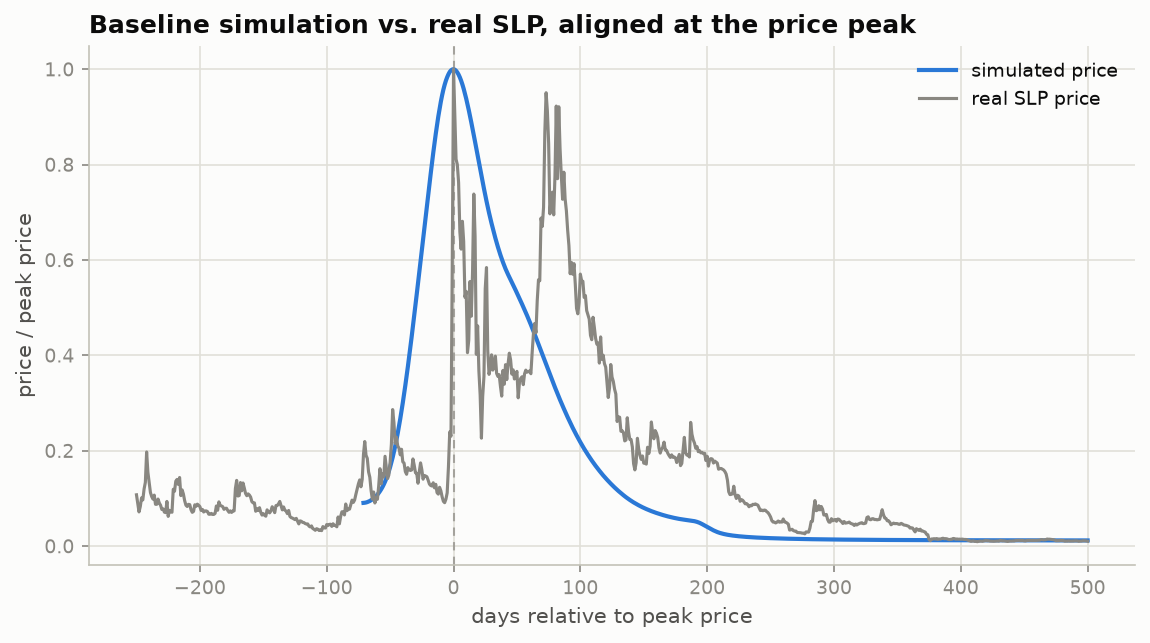
The overlay is honest about the fit: the simulated boom is steeper and single-peaked where the real series double-topped (May and July 2021, with the Katana-launch echo after), and the simulated collapse runs somewhat faster than the real ~223-day peak-to-−90% grind. What it reproduces is what the counterfactuals depend on: a boom driven by growth, a peak set by growth saturation rather than by any intervention, and a collapse to a near-zero floor that late emission cuts cannot reverse.
Counterfactuals
One knob changed at a time. "Solvent" = days until price falls 90% from its peak; "player-days" = cumulative daily active players over the 3-year horizon.
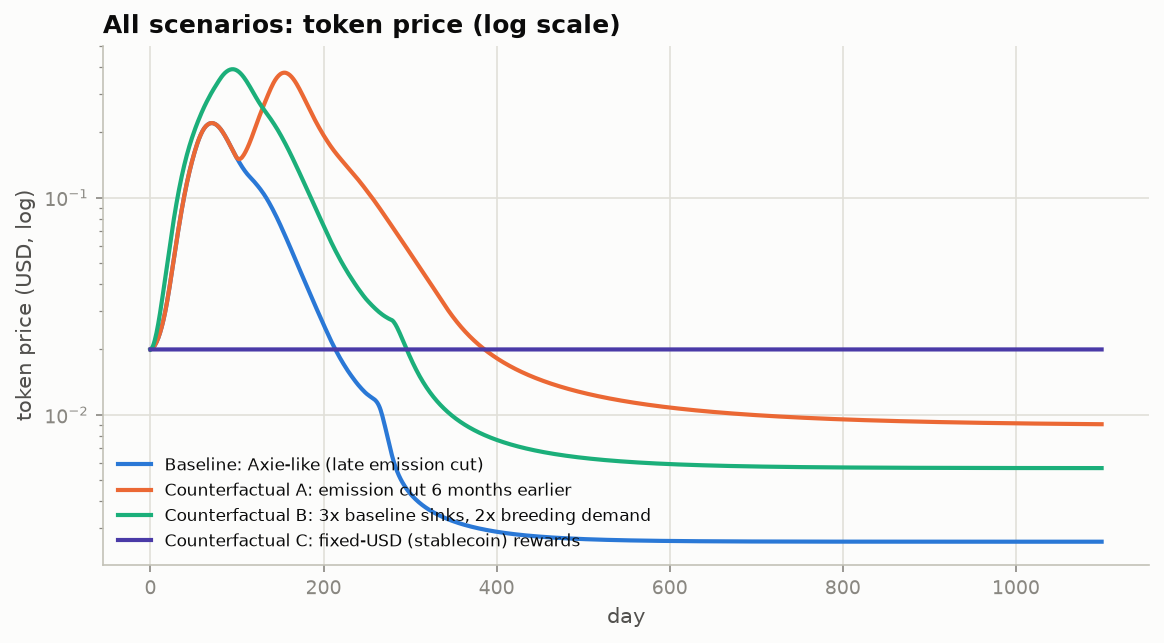
- A. Cut emissions at the peak, not after the crash (−55% at day 100 instead of day 280). Solvent 330 days vs 210 (+120 days, +57%); +154% player-days; the price peak is higher — sell pressure halves while demand is still growing — and ~43,000 players remain at horizon-end vs ~100. Same policy, different timestamp, roughly triple the economy. Timing is the whole game.
- B. Stronger sinks (3× baseline burn, 2× breeding demand). Solvent ~+30 days; ~+50% player-days. Sinks recycle demand but leave the earner cash-out flow untouched, so the structural imbalance — and the collapse — survives. This matches reality: Axie raised SLP breeding costs twice (Sep and Dec 2021, ending 6–9× launch cost) and shipped the Origins crafting sink; none of it reversed the trend. You cannot sink your way out of a faucet problem.
- C. Fixed-USD (stablecoin) rewards. No collapse within the 3-year horizon; +424% player-days; population stabilizes around 1.3M. Severing earnings from token price removes the reflexive loop entirely — there is no mechanism left to spiral. The trade-off moves off-chain: the studio now owes players a USD-denominated reward stream and must fund it from real revenue, which is a business-model problem rather than a token-design problem. (Our model grants the studio that solvency for free; a fuller model would not.)
What real games do now
The industry internalized exactly this lesson: by 2026 the dominant pattern for new web3 games is stablecoin-denominated rewards (scenario C) with tightly capped or purely cosmetic volatile tokens, plus sinks designed into the core loop from day one rather than patched in during the crash. Axie itself spent 2022–2024 running down the same checklist — emission moved to competitive play only (Aug 2022), then net-sink tournament economies (Jan 2024) — the interventions our counterfactuals say work, applied years after the window in which they would have mattered.
Limitations & future work
- The price model is a toy. Linear impact + smoothing has no order book, no liquidity migration, no exchange listings. We use it to study feedback structure, not to forecast levels.
- Cohorts, not agents. "Earners sell 90%" stands in for a distribution of scholars, managers, and holders; heterogeneity (e.g., guild treasuries buffering sell pressure) is out of scope.
- One growth channel. Player acquisition responds only to earnings; hype, marketing, and the 2021 crypto beta are folded into the growth-rate parameter.
- Calibration is qualitative. The baseline reproduces the shape of the SLP trajectory, not a fit to it; counterfactual deltas are orders of magnitude, not forecasts.
- Data gaps. CoinGecko's free tier no longer serves history older than 365 days, so deep price history comes from Yahoo Finance; supply is measured as cumulative net emission on Ronin (which excludes the small pre-migration Ethereum supply). Mint counts claims, not earnings. Active addresses ≠ players.
- Future work: fit the baseline properly, add a guild/treasury cohort, model the AXS side of the breeding fee, endogenize the studio treasury to price scenario C's real cost.
Sources
Every dated claim is recorded in data/events.yaml with a source URL — official Axie Infinity blog posts (Season 18, breeding adjustments, Season 20, Phase 3), plus CoinGecko, CoinDesk, Naavik, and contemporaneous coverage. Price/market data: CoinGecko (recent) + Yahoo Finance (2020–2025 daily history). On-chain mint/burn/addresses: Ronin data via the Dune queries in data/queries/, exported August 8, 2026.